Read it all for yourself. It's short but here's the money grafs anyway.
The current zeal for sending doctors to jail for writing painkiller prescriptions may seem baffling, especially to the patients who relied on the doctors for pain relief. But if you consider it from the perspective of the agents raiding the doctors' offices, you can see a certain logic.
You see it became so painfully apparent that the DEA is losing the war on some drugs, they had to find some way to bring up their arrest numbers and what better target than this?
As quarry for D.E.A. agents, doctors offered several advantages over crack dealers. They were not armed. They were listed in the phone book. They kept office hours and records of their transactions. And unlike the typical crack dealer living with his mother, they had valuable assets that could be seized and shared by the federal, state and local agencies fighting the drug war.
I don't mean to suggest that the doctors were all blameless, or that OxyContin wasn't being diverted to the black market and being abused. But the problem wasn't nearly as bad as federal and local authorities made it out to be.
Indeed. More people die of complications due to daily aspirin use than can be attributed solely to Oxycontin. In fact, there may be almost no deaths that could be attributed solely to the drug. A drug by the way that is extraordinarily effective and safe if used properly.
According to US army figures, out of the 4,000 men of the 256th Brigade Combat Team, 53 faced alcohol-related charges and 48 were charged with drug offences.
Those of course are only the ones that got caught. One would expect the actual number of users is much greater.
In another case, Pte Emily Hamilton told a court martial that she used a hashish pipe belonging to a colleague because "it helped me go right to sleep". She was given a year's confinement and a bad conduct discharge.
"Some of these young soldiers just can't handle the stress," said Capt Christopher Krafchek, a military defence lawyer.
The majority of drug-users are in their teens or early 20s, and sometimes get their drugs from local Iraqis while on patrol in Baghdad.
Troops caught in possession of illegal substances are either jailed, demoted or discharged from the forces.
Certainly an easier way to get out of the army than shooting yourself in the leg. Oddly, the one drug they don't test for is steroids, a well known cause of erratic behavior commonly called "steroid rage."
This is somewhat good news. In a setback for the malevolent DA David Capeless, the first of the Great Barrington 18 trials has ended in a mistrial. We followed this story previously, here, here and here. A jury of twelve deliberated for only nine hours before calling it quits.
"No one on the jury wishes to continue deliberations," Judge John A. Agostini said, reading from the final note from the panel, which twice declared themselves deadlocked.
...Two jurors who were approached outside of court declined to discuss the deliberations, other than to say that the panel was not "split down the middle."
..."It was a really hard case, and everyone tried really hard, but in the end, it just didn't work out," one of the jurors said. According to a note to the judge earlier in the day, debates in the jury room centered on issues of "beyond a reasonable doubt," and "strong feelings around harassment and entrapment."
"Some jurors have strong feelings on this," the note read. "All jury members feel that we cannot come to a final verdict."
The defense states the mistrial was evidence based and not a result of jury nullification but considering jury nullification is a hot topic on any drug policy forum and the fact that jurors have actually been arrested for exercising it, it certainly hints at a nullification without the risk.
It's not a great solution for the defendant who remains in legal limbo and must face a retrial but consider the impact if his next trial and the subsequent defendant's cases also deadlock. It is one way to nullify the dunderheaded school zone provision without getting arrested themselves.
In any event it's good to see Capeless thwarted in this witch hunt at least for the moment. The longer this remains in the public eye, the better the chances are that he'll be voted out of office despite his family connections.
NORML just released its 2005 "Truth Report", refuting for the what feels the millionth time, the biggest government lies about marijuana. Among the myths exploded are:
* "Nationwide, no drug matches the threat posed by marijuana."
* "The addiction to marijuana by our youth exceeds their addiction rates for alcohol ... and all other drugs combined."
* "Marijuana and violence are linked."
* "Marijuana is a gateway drug."
* "As a factor in emergency room visits, marijuana ... now surpasses heroin."
* "Marijuana is not medicine, and no credible research suggests that it is."
* "Smoked marijuana leads to changes in the brain similar to those caused by the use of cocaine and heroin."
* "Marijuana legalization would be a nightmare for America."
NORML Executive Director Allen St. Pierre said, "It's time to begin an honest public education campaign about the minimal risks presented by marijuana. Let's allow science, not rhetoric, to dictate America's public policy regarding marijuana. As you will see, the facts speak for themselves."
This stinks. We've been following Don Nord's case [scroll down] for a couple of years. Don was arrested and then exonerated for having three marijuana plants because he's a medical marijuana user.
The judge ordered the feds to return his plants and other equipment. The feds refused and the judge held them in contempt. Unfortunately, in this post-Raich climate, the feds just got away with it. A US District Court judge ruled that federal law enforcement officers cannot be held in contempt for failing to follow a state judge's order.
"I find that (the agents) were performing acts that were authorized or that they reasonably believed were authorized by valid federal law," US District Court Judge Walker Miller decided.
No surprise but disappointing all the same. It serves as a reminder that if we're going to get any meaningful policy reform, we're going to have to put more pressure on Congress to change the laws.
Well this was inevitable I suppose but it's one of those 2 million dollar boondoggles. That's what it cost a week just since 7/7, when they doubled the police force in response to the London bombings. Yesterday's overtime salaries will only add another set of zeros to that account. Money that would be much better spent on simply improving security on the platforms and maybe in the tunnels. I mean for God's sake, aren't there homeless people living under Grand Central. You think a terrorist is going to even bother going through the gates?
But then the transit authority doesn't appear to care about spending its money wisely. They had 600 million to spend on security improvements. Only 30 million of that was used in real services. The rest was spent on studies and consultants.
As it stands, the searching of one in five people in random stations gives the illusion of increasing safety but accomplishes virtually nothing in terms of actually preventing a London style attack on our mass transit systems. It's unlikely that the other four they miss couldn't someday be carrying a bomb. It is likely to catch quite a few drug possessors though and no doubt will cut down on say, marijuana dealers use of the subway. Guess it will balance out for the cab driver's though - I expect they might see more business out of this. Glad that someone will see a silver lining out of it.
Today NYC is doing random checks at mass transit stations. Other large cities are expected to follow suit once they see whether the constitutional challenges that are sure to be mounted, hold up or not. At this rate, you won't be able to go to the corner store for a soda without being searched and the irony is you still won't be any safer from terrorists but you just became a whole lot less safe from your own government.
And they wonder why I've started to believe in conspiracy theories. Looks like a shorter walk to the police state long desired by the Bushites every day.
A tunnel longer than a football field built to ship drugs under the U.S. border was shut down by law-enforcement officials yesterday. A source close to the investigation said the tunnel was being used to smuggle marijuana between Aldergrove and Lynden, Wash.
"This thing was under surveillance for the last eight or nine months," said the source.
...Built with timber walls and ceilings and lined with a cement floor, the tunnel is about 150 metres long, said the source.
...Separated by a ditch and a road, it ran from a private residence on the U.S. side to a quonset hut on the Canadian one in the 26700-block Zero Avenue, he added.
...[Neighbor] Luke said she never suspected anything illegal but often wondered why the house on the U.S. side was vacant. "It's a nice house. I thought that it was strange that there was no one living there for so long."
That's probably what tipped the cops off as well but it does go to show how cannabis importers make good neighbors. If they had been able to do that legally, that little town could have been making some serious money.
The trade in marijuana "is estimated to be worth over nine billion dollars Cdn a year. In fact, Forbes magazine called marijuana Canada's most important agricultural export.
The update is very interesting. Take this for instance.
Using a delayed notice search warrant, agents entered the home on July 2 to examine the tunnel. A short time later a U.S. District Court judge authorized the installation of cameras and listening devices in the home to monitor activities in the home. Using these devices, agents from various federal, state and local law enforcement authorities saw the three suspects carrying large hockey bags or garbage bags through the tunnel.
It stinks of the Patriot Act. That was supposed to keep us safe from terrorists, not cannabis dealers right? Interestingly the two accounts differ on the upkeep of the lawn.
This piece says tunnels are not uncommon and offers this odd bit of info on a bust at the Mexican border.
Investigators used a machine that can "see" underground, a video-equipped robot, a drug-sniffing dog and an air horn to find it..
Why the air horn, I wonder.
This flash video doesn't answer that question but does have it's own amusing take on the story.
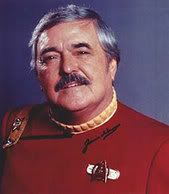
He was one of my favorite Star Trek characters of all time. The original series - and I was watching when it originally aired - was the best. I liked Second Generation okay, although I never loved Picard like I did Kirk. I warmed up to DS9 after a while. I have to admit I lost interest when they got to Voyager. The characters just didn't work and they finally ran out of story lines.
Scotty was likely to say, "A can nae change the laws of physics. I've got to have thirty minutes." His character will defy those laws and live on forever in reruns but the man who brought him to life cannot and paid the earthly price.
Israeli biotech company Pharmos is hot on pot, well make that chemically produced synthetic pot. Despite failed trials of its last drug, dexanabinol, in the treatment of traumatic brain injury, the company is still enthusiastically pursuing cannabinoid research.
It's unsurprising that Pharmos is undaunted by earlier failures with the stakes this high. The global pain market is said to be worth $26 billion and there's a dearth of appropriate drugs after the recent scandals around the safety of Vioxx and related pain meds and the alleged dispersion of addictive narcotic painkillers like OxyContin into the black market that the DEA is using to justify with it's war on pain doctors. The company has already come up with a new drug.
Pre-clinical studies carried out by Pharmos show that Cannabinor is as potent as morphine and other pain killers in providing pain relief and has a longer duration of action.
"But unlike morphine and other drugs on the market today, Cannabinor does not show any of the side effects, including constipation, drowsiness and addiction, associated with these drugs," says Kindler.
The development of Cannabinor comes at a time when there is extensive interest in cannabinoids in the pharmaceutical world. Dozens of companies are developing cannabinoid drugs for medical uses that include the treatment of cancer nausea, spastic disorders, epilepsy and sleepwalking.
It's like I've always said. The pharma corps were going to willing to acknowledge the medicinal properties of cannabis as soon as they figured out how to make enough money on it. It just took them a while to figure out how to vilify the evidence of 5,000 years worth of successful use of a natural herb that anyone can grow, in order to sell us a synthentic drug that only they can produce.
However there's not much incentive for patients to sign up. Lockyer's review also indicated "federal officials could use information from card applicants to prosecute them."
Just another perfectly good and effective program ruined by the Raich decision.
They both have their own axes to grind. Sherer, a MMJ patient herself, wants to get her medicine into the hands of the suffering and Tozzi wants to save his Act from an untimely demise at the hands of Congress. Fortunately, for drug policy reform, their goals meet in the middle and the two are working together to challenge the scheduling of marijuana as a Class I drug along with heroin and LSD.
The ONDCP is predictably not buying it.
Although there have been "suggestions" that some elements of the herb might be developed into prescription drugs, potential benefits are outweighed by a "manifest risk" of widespread abuse, said David Murray, a White House Office of National Drug Control Policy analyst.
Even if new marijuana-based drugs were approved, Murray said, they would not likely have "the character of the raw crude leaf."
Notice the change in rhetoric now that Andrea Barthwell is pitching for Sativex. All of sudden it's the "raw crude leaf" of natural marijuana that's not an acceptable medicine but pharmaceutically extracted derivatives are no longer villainous.
The consensus seems to be that the pair won't be able to crack the Bush administration's war on the plant itself and that it doesn't stand a chance to be reregulated. As one pundit puts it, "This has nothing to do with the medical debate. I think it's simply politics."
He's probably right, at least as long as Bush is in office, but I'm not willing to count this new dynamic duo out of the running yet. U.S. Health and Human Services officials have until Tuesday to respond to their request for reconsideration. I can hardly wait for their answer.
Mr. Paey, who is 46, suffers from multiple sclerosis and chronic pain from an automobile accident two decades ago. It damaged his spinal cord and left him with sharp pains in his legs that got worse after a botched operation.
He couldn't find a doctor who would prescribe enough medication to allow him to function so he did see several doctors. Unfortunately, one of the doctors, who was obviously afraid of DEA retribution, testified he didn't prescribe medications that he in fact, had prescribed. In spite of pharmacist's testimony in support of Paey, he was convicted under Draconian laws in Florida and sentenced to 25 years in prison.
Ironically, he receives better medication in prison, where they have furnished him with a morphine pump instead of the pills that landed him there in the first place. Had he been able to obtain that logical treatment on the outside without DEA intimidation of pain management physicians, he would be home with his family and contributing to the tax base instead of wasting away alone in a jail cell at the expense of your tax dollars.
There is no evidence he ever sold a single pill yet he was convicted of trafficking. It took the DA three tries to convict him. I think they only managed it because Rush's arrest had sent the media into a feeding frenzy about doctor shoppers and the black market in pain meds.
Rush, to remind you, had procured a great deal of medication on the black market. Paey had not. Yet Rush, who could afford lawyers to delay his case forever, is still free and receiving copious amounts of money to spew White House rhetoric.
The prosecution and incarceration of Richard Paey serves no purpose. This wheelchair bound man is clearly no danger to society and his sentence does not serve justice. He should be pardoned immediately. Unfortunately there's fat chance of that with Jeb Bush at the other end of the pen.
Holland's permissive drug policy has long been a source of friction between the two countries. Holland's success was making our prohibition policies look bad. However, Walters finally managed to get the "crack of marijuana" meme going on the federal level in Holland with this agreement. The two drug czars bonded over a new strain of high potency Dutch home grown marijuana being plied in the cafes there called THC.
"But on a visit to Holland earlier this year, I was struck by how much commonality there was over the issue of marijuana THC and high-potency cannabis," he said. "Their research showed that 20 percent of homegrown marijuana was THC, and they were having significantly greater problems with this. Dutch government agencies have been saying this almost ought to be treated as a different drug."
Having identified an area on which they could work together, Walters and Hoogervorst drew up a joint statement. The agreement paves the way for a summit this fall between U.S. and Dutch researchers, information sharing between drug addiction experts and the assignment of a Dutch researcher to the National Institute on Drug Abuse.
This isn't exactly news. We've heard these rumblings of discontent among the Dutch feds for probably a year or so now. The mayors and local legislators have so far managed to block any significant attempts to shut down the cafes or their suppliers though. It would be stupid when their tourism depends to such a large degree on the so-called drug tourists.
Nonetheless, it doesn't pay to underestimate a prohibition profiteer of Walter's caliber. We'll be watching for developments to see if anything more comes of this.
Rand did this study to judge the effects of drug policy reform on sentencing.
The study drew samples from California and Arizona prison inmates imprisoned for "low level" drug offenses, and reviewed them with these objectives in mind:
To characterize the prosecution resulting in prison sentences of drug possession offenses relative to drug sales and other nonpossession offenses.
To examine how marijuana is treated relative to other drugs.
To explore the racial implications of drug sentencing and plea bargaining practices.
To examine what factors influence plea-bargaining behavior and plea-bargaining outcomes.
To analyze whether Arizona's Proposition 200 has brought about changes in drug prosecution patterns that result in prison sentences.
The findings refute the wild claim that "the prisons are filled with marijuana offenders." At the same time, they provide a rich description of just who the typical imprisoned offender of this type is, actually providing ammunition for those who make more reasonable claims, but questioning some deeply held beliefs as well.
A quick perusal of the summary by an admittedly mathematically challenged layman here finds the conclusions a little vague and suspiciously presented to substantiate a foregone conclusion on behalf of the prosecutors. I don't think they did anything unethical but I don't like the way they quantified the data.
I note for instance, the use of prior convictions as determining whether the "dangerous offender" is being targeted rather than the casual user. It means little to say they had extensive priors without detailing what those charges were.
For instance if you're arrested for taking a leak behind a gas station because the restroom was locked, you're charged with public indecency - a serious charge that in MA requires you to register as a sex offender but hardly makes you danger to society.
Cops also have a proclivity to add A&B on an officer and resisting for instance and often it's not really true. In the statistics wouldn't that count the same as say an A & B on your neighbor in the stats? If it does, and I think that makes a difference, then I think it kind of renders the data meaningless.
The increase in paraphernalia charges is also interesting. It suggests to me that they are indeed skirting the intent of the reforms by charging them at drug offense levels when they aren't caught with actual drugs in order keep those warm bodies filling the cells. Gotta pay for that prison construction somehow.
Using weight as a criteria to judge severity of the offense is also ridiculous when comparing marijuana to other drugs. Big difference between an ounce of pot and ounce of coke in terms of how many "highs" a consumer will get from it. That of course is a problem with the way our government sets up the penalties and not a failing on the part of the researchers.
Nonetheless, it still renders the study meaningless in terms of evaluating whether violent criminals rather than non-violent drug consumers are being unreasonably incarcerated.
At first glance this bust may seem like a success story in the war on some drugs. Sounds pretty impressive doesn't it. Thirty two people busted, $13 million in cash and millions in private property seized. Law enforcement estimates the group did $178 million in trade. So what did Detroit and society in general gain from this bust. Absolutely nothing.
Start first with the cost of a 16 month long investigation involving 19 different law enforcement agencies. How many millions of dollars do you think that cost? I don't have a clue but assuming a conservative 2 agents from each agency, and a mean salary of $50,000 a year that's almost 3 million in salaries alone. That doesn't account for the expenses. Gas and upkeep for their vehicles, weapons, significant travel expenses and probably at least some payoffs to informants. Pretty soon you're looking at spending as much or more to catch the guys as the bust was technically worth.
Add in the court costs to prosecute the defendants and the cost of incarceration and before you know it, the taxpayer is a hole. Some may point to the forfeiture assets as a setoff to those expenses but that money does not go to the general welfare. It's given to the law enforcement agencies that seize them in order to continue funding more busts that leave the taxpayer holding the bag.
What have you gained for your money. Safety? Don't count on it. It should be clear from this bust alone, that breaking a rival organization only led to the currently busted group becoming bigger, more powerful and more violent as they had more to protect as they grew. Believe me when I tell you, that this bust may reduce the supply of drugs temporarily but in a matter of weeks some other enterprising entrepreneurs will be filling in the gap left by this bust. There's simply too much money to be made not to tempt another player into the game and shutting down the supply does not quell the demand. If punishment worked, we wouldn't have almost 2 and half million people incarcerated in what has now become the biggest prison gulag in the world.
Consider also that without prohibition, the $178 million in trade would have generated business tax income instead of law enforcement outlays. The moral of the lesson being, the least efficient and most destructive method of dealing with illegal drug consumption is prohibition. It's time to cut our losses in this war and start applying some common sense by legalizing and employing the same model of law enforcement we use in the regulation of the legal drugs such as tobacco and alcohol.
"I am not that high that I think I am going to win. I just want to give the finger to the system and rally others who feel the same way.," Forchion said.
His platform is that "Cannabis smokers are the only segment of the population begging to be taxed. "We believe in taxation not incarceration," Forchion said.
The biggest challenge he faces of course, is the police. They tend to arrest him regularly. But he has built something of a base among the constituency.
"The US Marijuana Party" got 7,000 votes in Burlington County. That was the most for any 3rd party candidate on the card according to Forchion.
"Take a toke and vote for the weedman," Forchion said.
We wish him luck on his latest foray into the political arena.
For a detailed scientific analysis of this stuff is, see Jeremy Bigwood's article, but let me it boil it down for you into layman's terms. It's basically a spore for a fungus that reproduces quickly and unlike chemical agents, never breaks down. Centuries from now, it could still be causing crop failures if run amok. And no one can really predict what it's going to do. It tends to mutate.
Our government, all the back to the Clinton administration has recognized mycoherbicide for what it is, a public relations liability and an environmental disaster. It's not allowed to be used in the United States and most Andean countries also prohibit its use. That doesn't bother the Congressmen however. They want it to be tested soon in a major drug producing country near you.
"I am very hopeful that with the proper scientific research and testing, mycoherbicides can be utilized as an effective tool to help eradicate poppy and coca fields around the world and ultimately reduce the flow of drugs coming into our country," concluded Chairman Burton.
Of course, it could also ultimately reduce the flow of corn, wheat and cotton since there's no way to control it, but these guys don't really care about some future world famine when they need some "winning" statistics in the war on some drugs right now.
The amendment was adopted into the bill. One hopes our more sensible legislators will head it off before it's actually funded.