I also got a lovely note from Chelsea Green Publishers thanking me for my posts on saying no to Gonzales and advising my free book was on the way. Since no one has ever sent cash, I believe this is our first "tip." Pretty cool and I really wanted the book. Thanks to the good folks at Chelsea Green for their generosity.
Meanwhile, I almost got a job blogging for Fox News. Their blog Tonguetied is diversifying into a multiple blogger format and they were taking applications from the public. I offered to put the balance in, as in their slogan - fair and.... I would have loved to do it, but needless to say I didn't get the gig. I did surprisingly receive a rather nice note from the editor however, telling me they weren't looking to shake up the format enough to include my point of view, but if they changed their mind (and I quote), "you're near the top of the list if we do." I've had worse rejections.
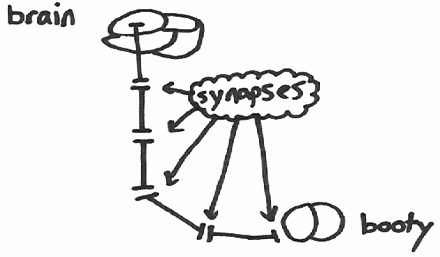
Written in easily understandable terms, it makes the science palatable to laymen and who doesn't want to know more about the brain to booty connection?
Patricia Tabram, the 66 year old grammy who was busted for cooking with cannabis can no longer save her pension money by growing her own but has kept her cannabis cooking circle alive by delegating procurement of the herb to other members of her little group and using other kitchens to prepare her dishes. She tells the Hexham Courant "As well as myself, the group consists of three women who suffer from multiple sclerosis and a man who has terrible arthritis. We all feel the benefits of eating cannabis."
She has strong reasons for continuing to risk further incurring legal charges.
Suffering from a multitude of ailments that strike the elderly, she tells us after embarking on a cannabis regime, "I have been pain-free, pill-free and my hearing aid is redundant. I have also gone from smoking 20 cigarettes a day down to six a week." I assume she means tobacco there.
It's clear why she would continue risking her freedom for the plant. What doesn't make sense is that she was ever arrested in the first place.
None of this would happen if we ended prohibition of some drugs. Just as the end of Prohibition I closed down the speak-easies and dismantled the criminal networks that provided bootleg booze, so the end of this prohibition would close down the crackhouses and put the backstreet dealers out of business.
Think about it. When is the last time you heard of cops shaking down people for a case of Budweiser?
Most are seemingly ordinary, middle-aged people. They include two lawyers, a teacher, boat captain, bartender, insurance adjuster, homebuilder, hairdresser, plumber, chef and artist. The most prominent is a college foundation board member, millionaire Charles Lamar Switzer, 54, who is awaiting trial on state charges.
I told you here a few weeks later about the main defendant, Domingo Gonzalez receiving a 17 year sentence for his role. He was indigent and couldn't afford a decent lawyer. Some kingpin. He never made money at it.
Now the defendants who do have money or status are coming to trial. TChris at TalkLeft updates us on the latest conviction. David Collins co-owner of a real estate school, who also once served on the Florida Real Estate Commission, received a 3 1/2-year state prison sentence Wednesday. He was charged for trafficking only because the prosecutors added up each little personal weekend buy until they reached a weight where they could lodge the charge even though he never sold any.
Defense lawyer Drew Pinkerton said Collins will appeal but will probably serve about 18 months even if he wins because Florida's drug trafficking law prohibits appeal bonds.
"It's the most draconian law in the world," said Pinkerton, who insisted his client was a recreational user, not a trafficker. "This guy goes to prison for 42 months and half the burglars and robbers are walking around the street out there on probation."
True enough, but as TChris points out, when it's a prominent businessman it's called draconian. But where are these guys when poor blacks and Latinos are being sentenced even more cruelly for less?
Human Rights First just released an excellent video illustrating the mentality of the man and also assembled a preponderence of evidence on why we can't allow his confirmation to go forward.
Meanwhile at Daily Kos, bloggers have issued a joint statement in opposition. I signed on in the comment section which at that time was close to 500 comments, many from bloggers. Kos also tells us Chelsea Green Publishing is giving away free copies of "Guantanamo: What the World Should Know" to all blogs who join the call to vote "no" on Gonzales. Email Margo Baldwin at mbaldwin@chelseagreen.com with your blog name, URL of post urging the "no" vote, and address.
But don't wait for the bloggers to do all the work. Call your senators yourself and leave a message that Gonzales has got to go. [Via Talk Left]
She's been raided twice, netting 31 plants and recently appeared in court where she pled guilty to possession with intent. She seems to be taking it all in stride.
She said: "When the police came to my door I invited them in. I told them to look in the loft and I offered them some tea and biscuits."
She's also written a book and is looking for a publisher.
(Thanks to Paul von Hartmann for the link. As he points out, folk remedies using various herbs have been utilized by grandmothers from the beginning of time. Patricia is clearly not a drug dealer but under the rules of prohibition she is still treated as such.)
Jules has a lot to say on the brutal excesses of our government-sponsored torture, which taken as whole as detailed in the volume is, as he puts it, enough to "nauseate any sane human being." Of interest to drug policy reformers however, is the analogy he finds between the conditions at Gitmo and those of our own prison system in the US, especially as related to the war on some drugs.
While many well-meaning people on both left and right profess to be shocked by the stories that continue to pour out of Guantánamo, Abu Ghraib and other detention centers, they usually fail to understand that these atrocities are well-rooted in American culture.
"None of what is known to have happened in Guantánamo is alien to American prisoners." says Paul Wright, Editor, Prison Legal News. Sexual assault, long term sensory deprivation, abuse, beatings, shootings, pepper spraying and the like are all too familiar to American prisoners. Coupled with overcrowding, this is the daily reality of the American prison experience."
Perhaps the only real difference is that the White House argues more forcefully than usual that no court can forbid it to arbitrarily detain and torture anyone it designates an unlawful enemy combatant, a definition that it has applied not only to foreigners but also to American citizens. We have seen how the drug exception to the Constitution has nullified basic American rights such a freedom from illegal search and seizure. But the war on drugs was merely a test run. Some rights remained intact. Now comes the permanent war against terrorism in which all human rights are annihilated.
And as we all know the Bush administration has been working overtime to form a nexus between terrorism and drugs with their continued references to narco-terrorists and the ONDCP's ads alleging smoking pot finances terrorism. Jules wonders if we are now bearing witness to the end of democracy in the United States. I have to wonder myself.
Meanwhile, I was stunned to discover in the local news that this little town actually has homeless people - they estimate there's probably a dozen of them. There's a big controversy about zoning for shelters going on. Somebody wants to start one and as always, nobody wants one in their neighborhood.
I'm appalled at this story myself, but unfortunately it's not illegal for a private company to dictate the terms of employment. Employees are forced to take drug tests every day in America and nicotine is just one more drug. Whether the owner can apply the policy retroactively depends on a number of factors but our courts have already ruled these invasive tests constitutional. I do however find the owner's behavior distressing and distasteful. You couldn't get me to work for that boor for any amount of money. I find it infuriating that he thinks has the right to meddle in his employee's private lives and even more so that the law allows it.
Another source reports that "the company also has programs in place to get employees to eat right and get more exercise." Those programs are not mandatory - yet. Today tobacco, tomorrow the Kripsy Kreme addict?
The report features background on the current situation, data on foreign hemp production and U.S. consumption, analysis of the legal situation regarding hemp foods, and a review of economic studies. "We are very pleased the Congressional Research Service has issued this report and hope that members of Congress will conclude from the research that the U.S. is falling behind other developed nations on industrial hemp cultivation and technology," says Eric Steenstra, President of Vote Hemp. "I believe we will see federal legislation introduced this year to allow farmers to grow non-psychoactive hemp for the first time since the 1950s."
That would be really good news. The ban on agricultural hemp is one of most short-sighted and counter-productive aspects of this addle-brained war on some drugs. Let them grow rope.
Tom Angell of Students for Sensible Drug Policy sends in some good news. Thanks to their efforts a Congressionally-appointed committee yesterday called for the removal of a question about drug convictions from the Free Application for Federal Student Aid (FAFSA). The question currently appears on the FAFSA because of a 1998 law that suspends financial aid eligibility for students with any drug convictions. Since the question was added to the FAFSA in 2000, it has affected more than 157,000 students.
The proposal to remove the drug question comes from a report issued today by the Advisory Committee on Student Financial Assistance, an independent committee created by Congress to advise on higher education and student aid policy. The report characterizes the drug conviction question as "irrelevant" and notes that its existence "...add[s] complexity to the form and can deter some students from applying for financial aid."
This group has been tireless in addressing the inequity of denying financial aid to students with even the most minor drug charges on their record and their work is an example to all reformers on how to change the system from within. Congratulations to SSDP for a job well done.
UPDATE: Tom Angell checks in with a comment to temper my enthusiam here. In his own words, "As a clarification, the committee's recommendation does not mean that the question will in fact be removed from the form. As we all know, the federal government has a history of not following its own recommendations. Remember Nixon and marijuana decriminalization in 1972?
In any case, this development is huge one, and it is very positive. Folks who want to contribute to SSDP's efforts to change misguided drug policies can do so here.
The actual target of the raid, a 24 year old charged with conspiracy (God they that love that charge) to possess and distribute marijuana, and with possessing a 9 mm handgun. One assumes that means they didn't find any marijuana on the premises either although the article claims the kid admitted importing 1000 pounds over three years. It may sound like a lot to nonconsumers but 300+ pounds a year is not a major operation that requires commando tactics to bring down.
And what is it with this penchant for breaking down doors and terrorizing people in their own homes these days anyway. These cops are watching too much television. There's no need for all this grandstanding and you read of these mistakes all the time. For all the prohibitionist's talk about drugs causing violence, it seems to me the ones causing the injuries to innocent people are the police, not the defendants.
This poor child will no doubt be scarred for life from this "unintended consequence" illustrating once again that drug policy enforcement is more dangerous than the use of the drugs.
The US is backing off on its plan to force aerial eradication of poppy fields down the Afghani government's throat. With the illicit drug trade forming some 60% of Afghanistan's gross domestic product, it's clear why Karzai would want to tread lightly on the issue but what's striking to me is the way the $780 million US tax dollars was being allocated for the proposed counter-narcotics programs. $152 million had been earmarked for aerial eradication beginning this month.
And how much were they planning to spend to rebuild the economy with an alternate crops? $40 million. Oh and "in the meantime, the United States has given $500,000 for a one-time program to deliver wheat seeds and fertilizer to farmers in Nangarhar province, one of the major poppy-growing areas."
They don't say what they're going to do with the other 580+ million. My guess is that's all for military expenses. Further, "the administration will ask for up to $1 billion in aid for Afghanistan in a supplemental budget request in early February."
Thinking of the Senlis Council's press release, it seems to me there's a simpler solution. We should buy the crop, turn it into legal morphine and simply pay the farmers enough to grow legal crops to make it worth their while to give up poppies. It wouldn't take that much. The farmers are not the ones making the money on the drugs. They are by and large poor people who simply grow the crop that gives the best return. Individually they still barely make enough to survive.
As former U.N. advisor in Afghanistan Barnett R. Rubin tells the Pak Tribune, "opium prices that had plummeted because of the bumper poppy harvest last year quadrupled on the expectation that eradication would make for a smaller crop this year."
Because opium can be stored indefinitely and sold when the price is right, the traffickers "are big supporters of crop eradication right now," said Rubin, who argues that supporting other forms of rural development is a better investment.
"The net result of crop eradication will be a net transfer of income from opium growers to drug traffickers," he said.
We need look no further than the failed model in Colombia to see the truth in that. The US has poured millions of our tax dollars into coca eradication there and you all know what little effect that's had on the amount of cocaine on the streets of our cities.
Unfortunately, Bush doesn't get the lesson. The administration is currently reworking the proposal. They still want to go on with the eradication by hand. Don't ask what's that's going to cost.
The court upheld this (in my opinion) Fourth Amendment violation by a vote of 6-2. "In a dissent, Justice Ruth Bader Ginsburg bemoaned what she called the broadening of police search powers, saying the use of drug dogs will make routine traffic stops more "adversarial." She was joined in her dissent in part by Justice David H. Souter."
"Injecting such animal into a routine traffic stop changes the character of the encounter between the police and the motorist. The stop becomes broader, more adversarial and (in at least some cases) longer," she wrote.
Rehnquist unsurprisingly in his current state of health, was absent - not that it would have helped. It likely he would have voted with the majority anyway.
Nora lays it out in plain language with an easy to follow timeline. From Mandatory Minimum Sentencing to the so-called US Sentencing Guidelines that were softened by Booker, followed closely by a prison building boom where The United States "quadrupled the number of prison beds by building one prison a week" in less than a decade, she puts the pieces of the puzzle together on how this country came to become the world's biggest jailer.
One story she tells strikes an especially bitter chord that resounds throughout the non-violent substance consumer inmate community.
I think it was about that time when I read of a young woman who mailed some LSD for a boyfriend, hoping her willingness to ignore his illegal behaviors would bring him back to her lonely life. If I remember correctly, she plead guilty and accepted the Mandatory Minimum based on doses of LSD she mailed. If she had gone to trial, she would have faced not only the scheme of Mandatory Minimum Sentencing, but also the full range of US Sentencing Guidelines. By "copping to a plea," she could avoid one rail of sentencing.
While she was in prison, she called her mother and during one call three men broke into her mother's home, miles and miles away, and the young federal prisoner heard the rape of her mother begin. To make a long story short, the three rapists got out of prison before the young drug law violator did.
Nora reminds us that Booker didn't end the fight for sentencing reform and that without retroactivity many still pay with what could have been productive lives, wasted behind bars for this senseless war on some drug consumers.
She also points us to an enlightening statement from the The Senlis Council, "an international drug policy think tank said that President Karzai’s priority should be to tackle the drug problem in Afghanistan with new policy initiatives as the current situation risks undermining the fragile newly formed Afghan democracy."
“President Karzai is right in opposing the chemical spraying for crop eradication which has been proposed by the United States,” said Emmanuel Reinert, Executive Director of The Senlis Council. “Any kind of action against Afghan farmers would be catastrophic, especially before the Parliamentary elections. Even manual eradication would have very negative effects on the community as it would discourage allegiance to the state and encourage deeper ties with war lords who would be seen by farmers as more understanding of their plight.”
The Senlis Council said that realistic solutions to the drug problem in Afghanistan need to be proposed by the international community and that measures such as forced eradication should not be considered as they would be very damaging to the fragile democracy.
Citing a global shortage of legal morphine for pain relief, the Council rightly notes that "putting the opium market in the hands of Afghan businessmen and farmers instead of in the warlords can only help build the Afghan state," said Emmanuel Reinert. "Drug production in Afghanistan is a global problem which demands global cooperation to find the solutions."
They go on to point out "this year’s 64% increase in Afghan opium production as illustrates a massive failure of the U.S.-led ‘war’ approach to drug control, and that the current strategy for drug control endangers the future of Afghanistan."
They understate the problem - from the coca plots of Colombia to the poppy fields in the East - the US war on some drugs endangers the whole planet.